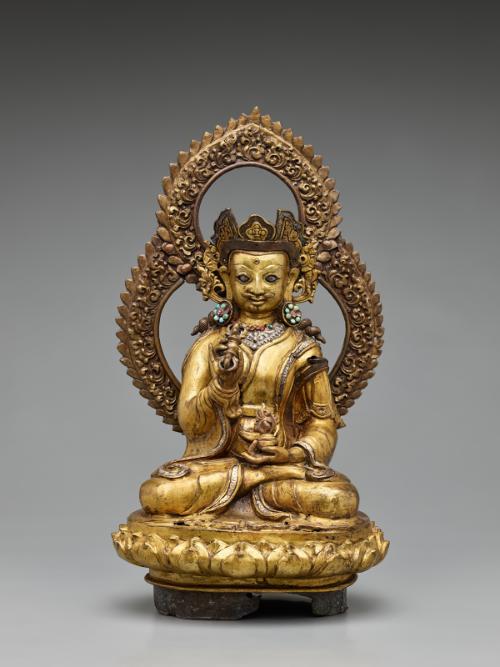


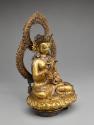


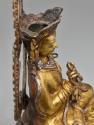
The Buddhist lama Padmasambhava
- Gallery Location Gallery 12
Padmasambhava was an eighth-century Kashmiri sorceror. But he was destined to became Tibet’s legendary Guru Rinpoche and source of the Nyingma or Ancient order of Tibetan Buddhism. How did this happen? It started when the Tibetan King Trisong Detsen invited him to Tibet for a specific purpose: to tame the spirits objecting to the king’s new Buddhist monastery of Samye. Padmasambhava tamed the spirits and completed the monastery. Subsequently he introduced powerful meditative practices into the Land of Snows (literally Hima-alaya or snow-abode).
Among Padmasambhava’s greatest meditative teachings are those focused on Dzogchen or the Great Perfection. This system of meditation aims to help the student directly recognize the intrinsic nature of mind. In a favorite metaphor we are told that the mind is innately luminous and pure, like a clear sky.
Padmasambhava instructed practitioners meditating in this system not to think about time in any of its phases of past, present, or future. Engaging with these constructs merely obscures the mind’s natural clarity. Similarly, he cautioned against interfering with the mind, as efforts to manipulate thoughts or emotions only reinforce the illusion of subject and object duality. Instead, Dzogchen invites practitioners to rest in the present moment, free from conceptual elaboration, and to recognize awareness as self-arising and self-dissolving.
Padmasambhava transmitted these teachings to his closest disciples, who helped preserve and transmit them through teachings, called terma or treasure, that he would hide at secret locations in the earth (or sometimes in the minds of disciples) for revelation at just the right time.