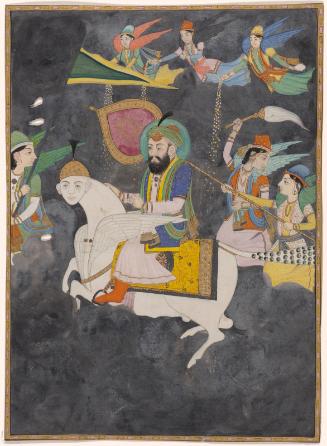

The prophet Muhammad in the cave of Hira, page from a Hamla-yi Haidari manuscript
This painting depicts the Prophet Muhammad in the cave of Hira, a retreat where he meditated and prayed and where he experienced his first revelation from the angel Gabriel. In this work, the face of the Prophet is behind a veil, a convention sometimes used in Islamic art. The Qur’an does not explicitly forbid rendering images of living creatures, but some Muslims believe that these images—especially depictions of revered figures like the Prophet Muhammad— should be avoided. Images such as this that contain venerated individuals are not considered objects of worship but rather illustrations of holy subjects. This painting was recently examined using X-ray technology to reveal that its artist had sketched out a face prior to painting the white veil, suggesting that even though the face was not part of the final composition, it was an important part of the figure.
(Label from exhibition "Haroon Mirza: The Night Journey")