

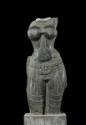
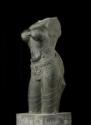
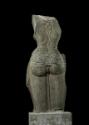
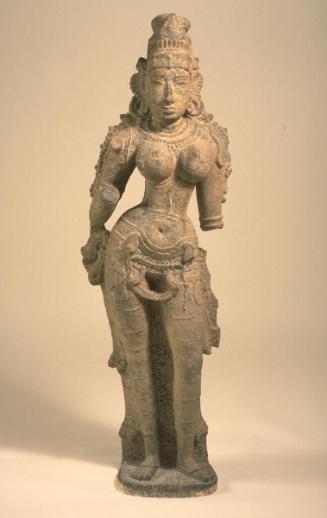
Torso of a female deity
Place of OriginSouthern India
Date1400-1600
MaterialsGranite
DimensionsH. 45 1/2 in x W. 16 1/2 in x D. 13 1/2 in, H. 115.6 cm x W. 41.9 cm x D. 34.3 cm (w/o base)
Credit LineThe Avery Brundage Collection
Object numberB63S3+
DepartmentSouth Asian Art
ClassificationsSculpture
On View
Not on viewThis Indian stone sculpture seems powerful and timeless, subtly shifting
her weight to one side. But this goddess is a fragment of her former
self, missing a head, arms, and lower legs, which are now supported by
a concrete block added at some point in the twentieth century. When
the sculpture was exhibited in the past, this block was encased in a
wooden pedestal and wasn't seen. I argued to leave it exposed this time.
Exhibited as "Torso of a female deity" this broken deity bears the guise
of a complete artwork, diverting our attention from what was lost.
What would it mean to acknowledge the damage here? Recovering
our awareness of the figure's losses broadens the goddess's allure. Her
acquired cracks and fractures suggest the collision between ideal beauty
and the world of time and nature. Our experience oscillates between past
and present, beauty and decay, myth and reality.
AH
What of the poignant disfigurement here? Beauty decays, and
gorgeousness may well have an element of pain.
This sculpture has not been on view for more than a decade. When it
was last considered for display there was some feeling that its damage,
given its subject, might lead to misunderstandings or make visitors
uncomfortable.
The centuries have robbed a voluptuous female figure of a head, arms,
and feet, leaving the figure seemingly deprived of consciousness and the
ability to move or take action. All that is left are the breasts, belly, thighs,
and buttocks, with their associations with sexual fascination. The figure
has been ogled and fondled, bought and sold who knows how many
times before ending up in a museum.
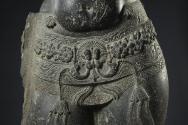
But, given an acknowledgment of the issues, why not show the
sculpture? As an artwork, it is pretty stunning, it seems to me. How
carefully the sculptor has created the narrowing and swelling volumes
by carving away the stone matrix, and has contrasted broad smooth
surfaces with areas of intricately detailed ornament.
FMcG
her weight to one side. But this goddess is a fragment of her former
self, missing a head, arms, and lower legs, which are now supported by
a concrete block added at some point in the twentieth century. When
the sculpture was exhibited in the past, this block was encased in a
wooden pedestal and wasn't seen. I argued to leave it exposed this time.
Exhibited as "Torso of a female deity" this broken deity bears the guise
of a complete artwork, diverting our attention from what was lost.
What would it mean to acknowledge the damage here? Recovering
our awareness of the figure's losses broadens the goddess's allure. Her
acquired cracks and fractures suggest the collision between ideal beauty
and the world of time and nature. Our experience oscillates between past
and present, beauty and decay, myth and reality.
AH
What of the poignant disfigurement here? Beauty decays, and
gorgeousness may well have an element of pain.
This sculpture has not been on view for more than a decade. When it
was last considered for display there was some feeling that its damage,
given its subject, might lead to misunderstandings or make visitors
uncomfortable.
The centuries have robbed a voluptuous female figure of a head, arms,
and feet, leaving the figure seemingly deprived of consciousness and the
ability to move or take action. All that is left are the breasts, belly, thighs,
and buttocks, with their associations with sexual fascination. The figure
has been ogled and fondled, bought and sold who knows how many
times before ending up in a museum.
But, given an acknowledgment of the issues, why not show the
sculpture? As an artwork, it is pretty stunning, it seems to me. How
carefully the sculptor has created the narrowing and swelling volumes
by carving away the stone matrix, and has contrasted broad smooth
surfaces with areas of intricately detailed ornament.
FMcG

approx. 1000-1050

1000-1050

approx. 1400-1500

1300-1400
approx. 1200-1400
approx. 900-1100
approx. 1000-1100

1300-1500
approx. 1000-1200
approx. 1600-1800

perhaps 1600-1700