
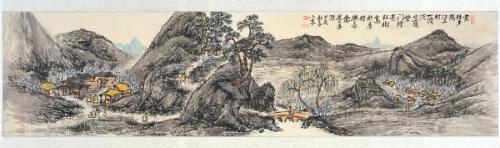
Landscape with figures
Artist
Byeon Gwan-sik
Korean, 1899 - 1976
Date1964
MaterialsInk and colors on paper
DimensionsH. 12 3/4 in x W. 50 3/8 in, H. 32.3 cm x W. 128.0 cm (image); H. 18 1/4 in x W. 61 in, H. 46.4 cm x W. 154.5 cm (overall with frame)
Credit LineMuseum purchase
Object number1997.1
DepartmentKorean Art
ClassificationsPainting
On View
Not on viewThis artist is most famous for his works executed in an assertive style and depicting the famous Diamond Mountain (Geumgang-san), in what is now North Korea. As illustrated in this work, however, Byeon also painted in a lyrical style, using a gentle and relaxed brushwork manner closer to the spirit of Korean amateur scholar- painter tradition. Here he returns to his memories of the Korean countryside from his years of wandering, and paints a quiet scene of hills, mountains, winding roads, small villages nestled in the valley, and ordinary people going about their daily tasks.
Byeon is considered one of the four twentieth-century masters in traditional Korean painting. At age eleven, he came to live in Seoul with his maternal grandfather, Jo Seok-jin (1853 - 1920), the last court painter at the Bureau of Painting (Dohwaseo) at the Joseon dynasty (1392 - 1910) court. After graduating from middle school, he pursued his studies in painting under the tutelage of two famous painters, his grandfather and An Jung-sik (1861 - 1919), both of whom were instrumental in preserving the tradition of Korean painting during the first half of the twentieth century.
Byeon's career as painter began when he submitted his works to the Seohwa Hyeophoe Jeon (Calligraphy and Painting League Exhibition) in 1921, and to the Joseon Misul Jeollamhoe (Korean Art Exhibition) in 1922. His studies led him to Tokyo in 1925, where he stayed until 1929. After his return to Korea, which was by then under Japanese colonial rule, he abruptly turned his back on officially sanctioned exhibitions and Seoul's art world to take up a life of wandering for the next ten years, until 1939. During these years, he visited all the famous mountains and monasteries in Korea, which later became the main themes of his work. His best works, which dealt with many wondrous scenes of the Diamond Mountain, were painted between 1957 and 1965.
Byeon is considered one of the four twentieth-century masters in traditional Korean painting. At age eleven, he came to live in Seoul with his maternal grandfather, Jo Seok-jin (1853 - 1920), the last court painter at the Bureau of Painting (Dohwaseo) at the Joseon dynasty (1392 - 1910) court. After graduating from middle school, he pursued his studies in painting under the tutelage of two famous painters, his grandfather and An Jung-sik (1861 - 1919), both of whom were instrumental in preserving the tradition of Korean painting during the first half of the twentieth century.
Byeon's career as painter began when he submitted his works to the Seohwa Hyeophoe Jeon (Calligraphy and Painting League Exhibition) in 1921, and to the Joseon Misul Jeollamhoe (Korean Art Exhibition) in 1922. His studies led him to Tokyo in 1925, where he stayed until 1929. After his return to Korea, which was by then under Japanese colonial rule, he abruptly turned his back on officially sanctioned exhibitions and Seoul's art world to take up a life of wandering for the next ten years, until 1939. During these years, he visited all the famous mountains and monasteries in Korea, which later became the main themes of his work. His best works, which dealt with many wondrous scenes of the Diamond Mountain, were painted between 1957 and 1965.
There are no works to discover for this record.