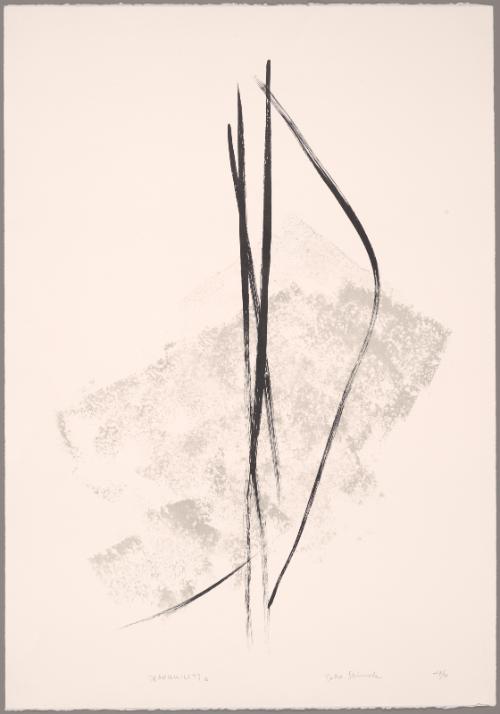
Tranquility B
Shinoda Toko (1913–2021) was known for pioneering abstract calligraphy in twentieth-century Japan. She revolutionized ink abstraction, pushing beyond the confines of traditional calligraphy.
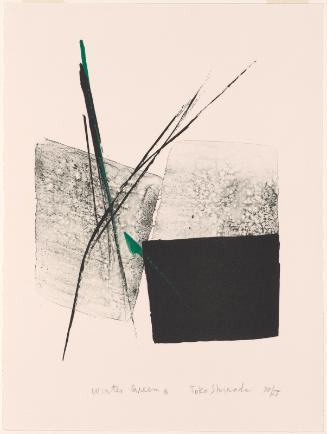
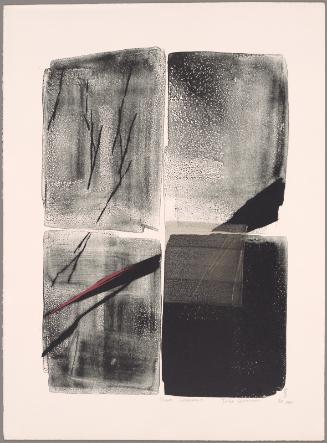
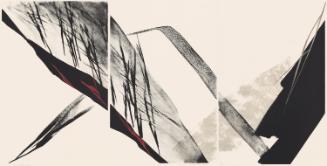
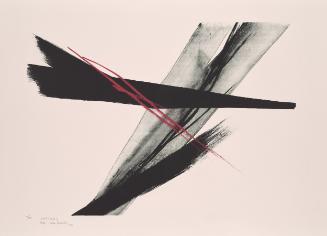
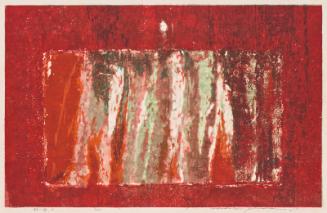
As the prints and painting displayed nearby demonstrate, Shinoda’s use of bold ink lines and shapes, combined with a subtle play of ink tonality, creates a sense of visual depth and expansiveness on the flat picture plane. Her minimalist, well-balanced compositions, limited color palette, and swift brushstrokes are key characteristics of her style. These works embody Shinoda’s innovative approach to traditional calligraphic materials and techniques.
Born in Dalian, China, and raised in Tokyo, she studied calligraphy under her father, but from a young age she felt uneasy with the conventional practice of copying the works of famous calligraphers from the past. She once explained, “It’s like creating a fake. . . . If you’re skilled at copying, you receive praise—and that seems strange.”
Shinoda initially brushed legible Chinese characters at the start of her career, but in 1947, she transitioned to her distinctive style of ink abstraction, characterized by dynamic brushstrokes. Her unconventional works, however, were not widely embraced in Japan at the time, which may have contributed to her decision to move to New York for two years in 1956. Shinoda said, “I wanted to see how my works would be received in a foreign country, where letters are not read as letters.”
Calligrapher at heart, Shinoda favored lithography over Japanese traditional woodblock printing because it allowed her to brush her designs directly onto the plate, capturing the subtle nuances of each stroke. In many of her lithographs, she added color by hand, making each piece unique. Over the course of her long artistic career—spanning until her passing at the age of 107—Shinoda continually sought her own definition of beauty, unencumbered by traditional calligraphic conventions.