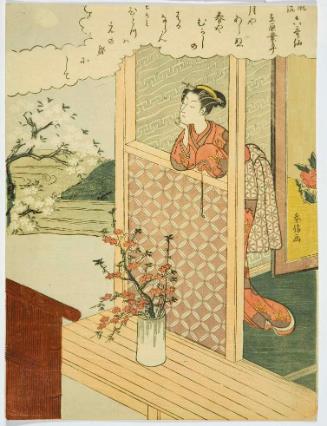

The Cloth-Fulling Jewel River, a Famous Place in Settsu Province
Artist
Suzuki Harunobu
Japanese, 1725 - 1770
Place of OriginJapan
Date1769-1770
CultureJapanese
MaterialsInk and colors on paper
DimensionsH. 27 in x W. 4 1/2 in, H. 68.6 cm x W. 11.4 cm (hashira-e)
Credit LineGift of the Grabhorn Ukiyo-e Collection
Object number2005.100.37
DepartmentJapanese Art
ClassificationsPrints And Drawings
On View
Not on viewSignedSignature: 春信画 Harunobu ga
Text Entries鈴木春信筆
『風俗六玉川』「
擣衣の玉川 摂津国の名所」 This long, narrow print frames a glimpse of a young prostitute at leisure. Still in her bedclothes,she uses a bamboo pick (
mimikaki) to clean one ear while standing on a veranda. Secured at thewaist with a loosely tied sash, her robes fall open below the knee, revealing a bit of bare leg. In the
garden are autumn plants and a grasshopper. Edo-period viewers would have enjoyed the witty
combination of this intimate contemporary scene with the classical poem inscribed at the top.
matsukaze no
When the wind passesoto dani aki wa
in the pines, autumn alreadysabishiki ni
seems lonely enough—koromo utsu nari
and then a fulling block echoestamakawa no sato
through Tamakawa Village.By mentioning the distinctive sound of fulling, a process of softening and drying cloth by pounding
with a wooden mallet, the lines refer to the Cloth-Fulling Jewel River, one of six rivers commonly
cited in court poetry. A square panel frames a picture of the poet, a woman known as Sagami (active early eleventh century).




Suzuki Harunobu