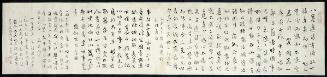


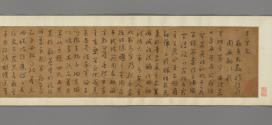
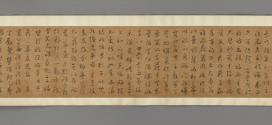

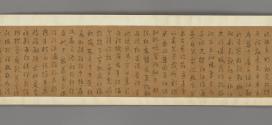


Thousand-Character Essay (Qianziwen), in Semicursive Script (Xingshu)
Image (2nd from right): H. 10 in × W. 168 5/8 in (25.4 cm × 428.3 cm)
Image (3rd from right): H. 10 1/2 in × W. 36 in (26.7 cm × 91.4 cm)
Overall: H. 12 5/8 in × W. 334 5/8 in (32.1 cm × 849.9 cm)
元箝復瞴書《千字文》卷
The Thousand Character Essay is said to have been assembled by the Liang dynasty emperor Wudi (502–549) as a form of instruction in calligraphy for his princes. One thousand nonrepeating characters were selected from works by the calligraphy sage Wang Xizhi (303–361) in the imperial collection and then put to rhyme by Zhou Xingsi (d. 521). Zhou shaped them into four character lines, reflecting various subjects such as nature, society, history, ethics, and so on.
Ever since it was composed, the Thousand Character Essay has served both as an instructional primer for children learning reading and as a model for calligraphers, who enthusiastically practiced it in various script types, including seal, clerical, cursive, semicursive, and standard.
Dong Fu closely studied the style of the famous early Yuan calligrapher Xianyu Shu (1257–1302). This is the only work in existence by this little-known master.
Curator's voice: The first time I saw this calligraphy I was taken by a nagging feeling of familiarity—I had seen the essence of this calligraphy before. Following this inkling, I realized that the strokes of Dong Fu—reminiscent of those of the famous early Yuan calligrapher Xianyu Shu. After further exploration of the colophons associated with this work, I found that indeed Dong Fu studied the style of Xianyu Shu, and so I was able to complete the link between these two Yuan calligraphers.