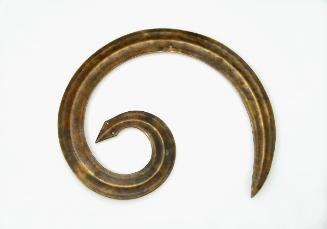
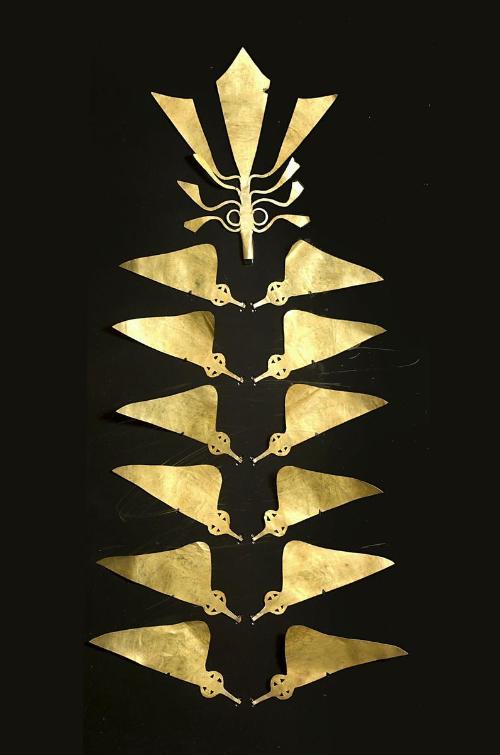
Section of a man's headdress
Sumatra is rich in gold deposits that were exported throughout the Indonesian archipelago. Gold on the island has long been treasured for its luster, malleability, and resistance to corrosion. Ancient Indian texts describe a region called “Suvarnadvipa,” or the “Isle of Gold” thought by many scholars to refer to the Indonesian islands, particularly Sumatra. In many Indonesian island cultures, including that of Sumatra, gold was associated with the sun and with the ancestral deities. Accordingly, gold evokes the symbolism of death and rebirth as exemplified by the setting and subsequent rising of the sun.
The island of Nias off the western coast of Sumatra is known for its gold jewelry. This finely wrought gold spire was once part of a headdress worn by noblemen in southern Nias. Its fishtail palm shape evokes the Tree of Life, a motif common to the arts of Nias and many other Southeast Asian islands.
(Label from Exhibition Hidden Gold: Mining Its Meaning in Asian Art)