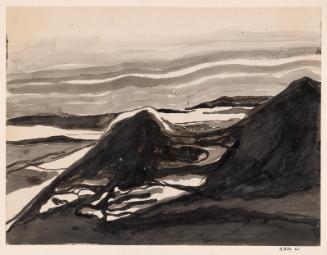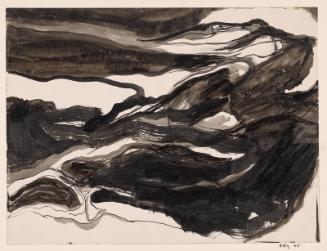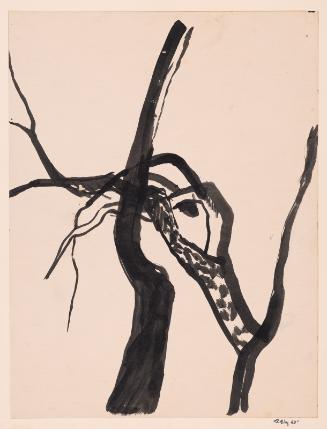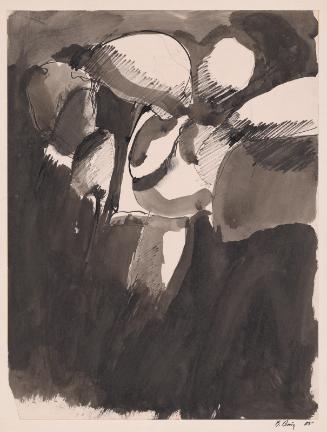
eau, ile, pierre
Born in 1951 in Busan, Korea, Theresa Hak Kyung Cha emigrated to San Francisco with her family at the age of twelve. Her pioneering work is often informed by her family’s diasporic past. In the 1940s, Cha’s parents were exiled to Manchuria by the Japanese colonial government. They then fled to Busan during the Korean War (1950–1953), and eventually came to the United States, where Cha received degrees in comparative literature and art at the University of California, Berkeley.
Manipulation of language is a crucial tool Cha uses to explore an identity marked by serial migration and displacement. Her fluency in Korean, English, and French as well as her deep understanding of various mediums enables her to experiment with language in her works on paper, performance, sound, video, installation, and more. The deliberately multifaceted quality of her art practice reflects Cha’s refusal to be categorized.
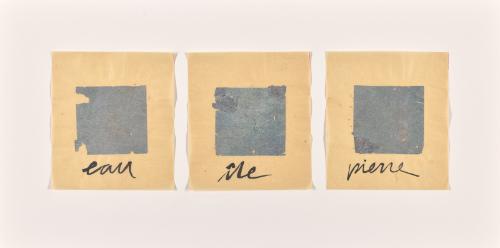
This piece, eau, île, pierre—which translates to water, island, stone—is written with ink on joss paper, a traditional Chinese paper typically burned as an offering to deceased ancestors, and a material that was available in New York City where she lived. This work preceded a genre-bending magnum opus, Dictee (1982), published a week before she was raped and murdered at the age of thirty-one. Despite her short career, Cha’s work continues to have an enduring impact on artists and writers today.