

Dragon pendant
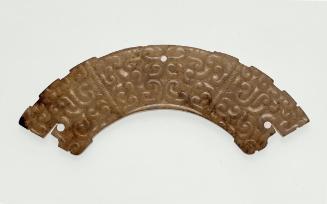
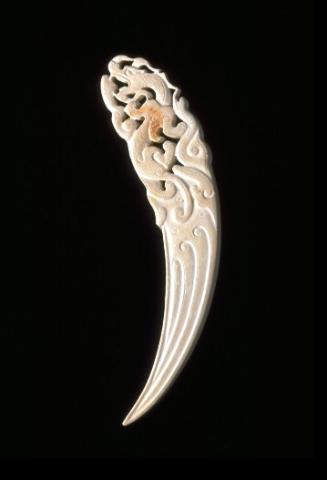
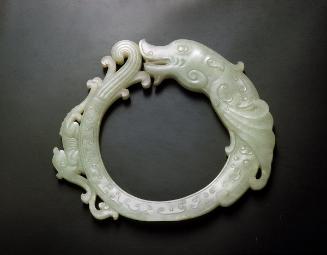
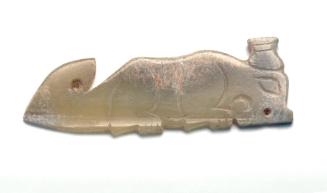
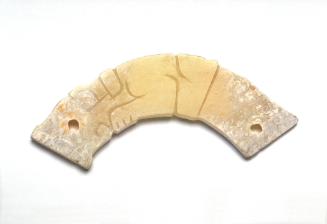
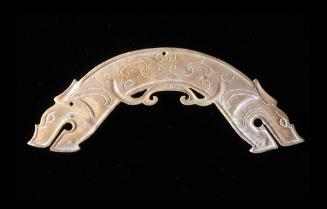
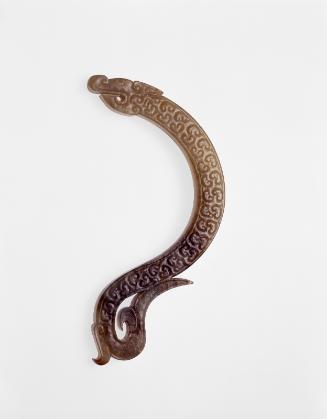
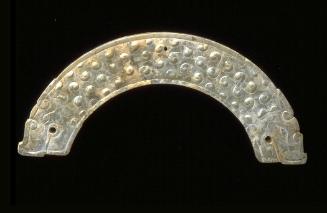
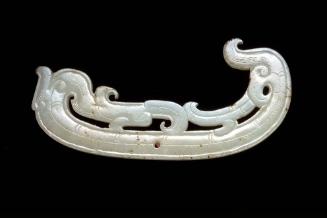
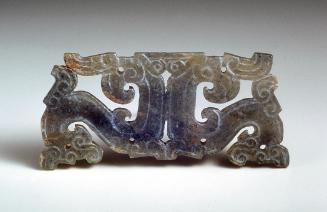
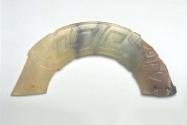
Curved almost in a semicircle, this pendant is carved from translucent green jade with black veins and brown areas. A dragon is worked on both faces, primarily in double parallel lines of intaglio. The beast has a single horn, a single paw, and a curled tail. The perforation on the nose was drilled from one side; two others, in the open mouth and at the other end, were drilled from two sides.
The semicircular form and the close double parallel lines across the body were used particularly for Shang dragon pendants. Excavated pendants found in Zhou tombs mostly depicted dragons realistically, in profile on both faces of the pendant, with the head and tail at opposite ends. They all demonstrate a consistent style—the dragon's mouth was executed as a slit perforated by a round opening with serrated edges; the tail was indicated by a round hole; an additional hole for suspending the pendant was located anywhere along the dragon's notched back ( Zgyqqj 1993, vol. 2, plates 100–101, 103).
This new piece was cleverly worked so that colored areas accent the dark head and strips of the body. But the poorly proportioned body, the irregular semicircle, and the notches on both back and belly are inconsistent with standard Shang dragon pendant. Both the number and the arrangement of the holes do not follow the design that Shang artisans would have used.