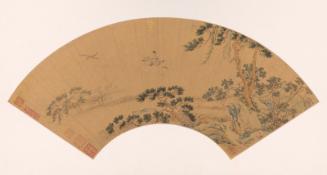
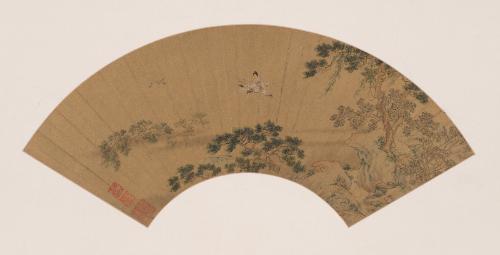
Immortal Flying on Crane
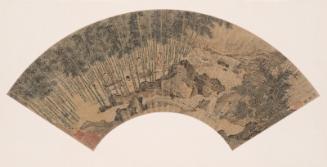
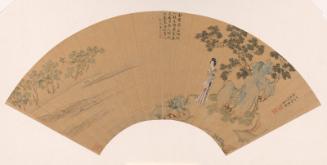
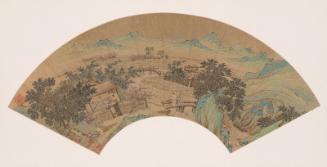
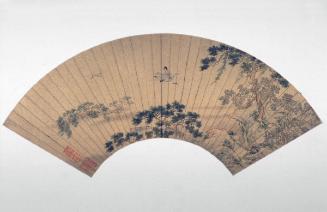
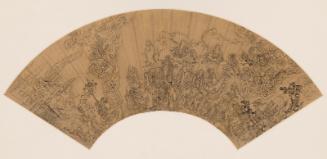
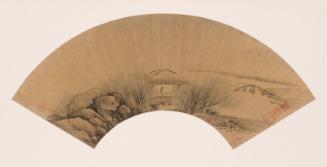
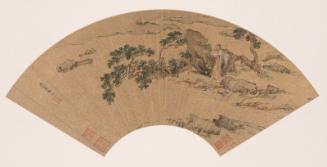
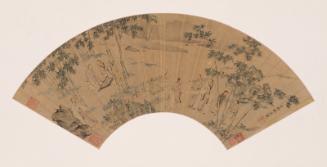
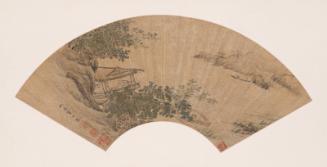
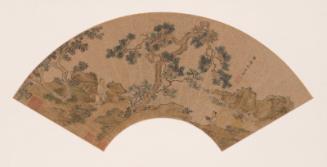
During the sixteenth century, the artist Qiu Ying sparked a fashion trend among the wealthy citizens of Suzhou, just northwest of Shanghai. He created fans out of gold-flecked paper, which were painted with a variety of motifs that recall important Chinese mythical themes. These fans, when folded up, could be carried in the long, loose sleeves of gowns worn by both men and women, and casually displayed at a desired moment. Such fan paintings were among the most sought-after luxury goods of the time, and the ownership of a Qiu Ying fan thus became a symbol of social status and sophistication.
The gold ground of the fan paintings symbolizes high value and thus status. Beyond this, however, these two fans employ painted imagery that emphasizes the symbolism of immortality. On one fan (B79D5.a), one of the eight Daoist Immortals can be seen riding on a crane, symbol of transcendence. On the other (B79D5.i), the Seven Sages of the Bamboo Grove—at least one of them immortal—grace the golden background. In these fans, the substance of gold and the theme of immortality find common ground on what might otherwise be a rather common substance: paper.
(Label from Exhibition Hidden Gold: Mining Its Meaning in Asian Art)
- Immortal
- crane