
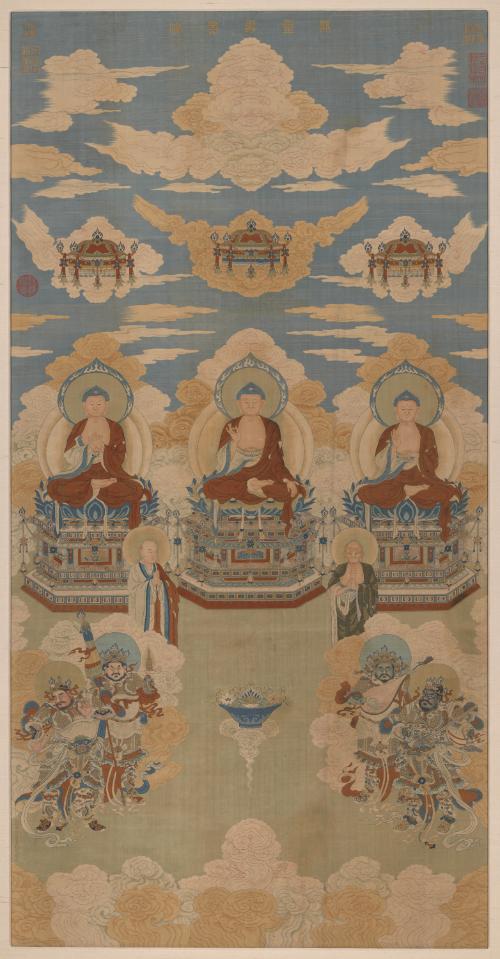
Buddhas of the Three Generations
Place of OriginChina
Datedated 1744
DynastyQing dynasty (1644-1911), Reign of the Qianlong emperor (1736-1795)
MaterialsKesi (woven silk tapestry)
DimensionsImage: H. 46 1/2 in × W. 23 5/8 in (118.1 cm × 60 cm)
Framed: H. 53 7/8 in. × W. 30 5/8 in × D. 1 5/8 in (136.8 cm × 77.8 cm × 4.1 cm)
Framed: H. 53 7/8 in. × W. 30 5/8 in × D. 1 5/8 in (136.8 cm × 77.8 cm × 4.1 cm)
Credit LineThe Avery Brundage Collection
Object numberB60D102
DepartmentChinese Art
ClassificationsTextiles
On View
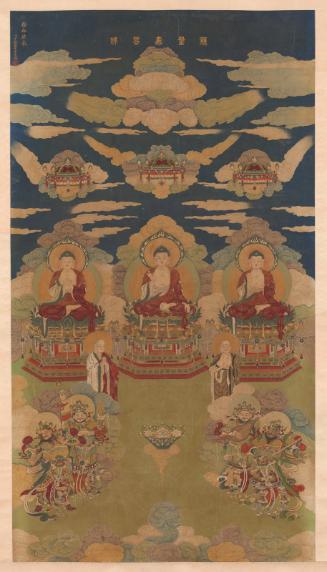
Not on viewInscribed"Buddhas of Infinite Life" - see 2000.7
Text EntriesThe Manchu Emperor Qianlong was an active supporter of Tibetan-style Buddhism. Not only did he commission many Buddhist images as gifts for his family members and for the religious leaders of Mongolia and Tibet, but he also posed several times for Tibetan Buddhist thangkas (paintings), sitting on a lotus pedestal dressed like a lama. The emperor’s patronage of Buddhism led to various new image forms, especially in painting and textiles. A fine example is this colorful woven iconic image depicting the three generations of Buddhas on a lotus throne in the center of the composition: Kashyapa (Buddha of the Past, on the right), Shakyamuni (Buddha of the Present, in the center), and Maitreya (Buddha of the Future, on the left). They are accompanied by two followers of Shakyamuni and four heavenly kings in the foreground. Over their heads is a canopy emerging from clouds. The background is composed of cloud swirls.
Kesi, translated as “cut silk,” is a type of tapestry weave that gets its name from the slits that occur between the colors where they meet vertically along the warp.
Kesi, translated as “cut silk,” is a type of tapestry weave that gets its name from the slits that occur between the colors where they meet vertically along the warp.
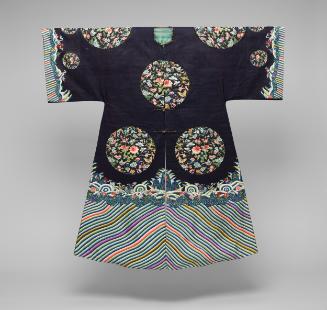
approx. 1875-1900
prob. 1750-1911
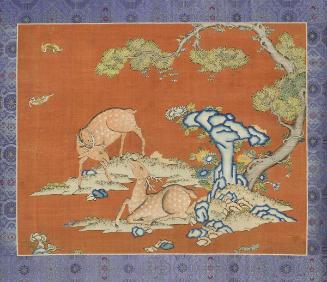
approx. 1800-1900
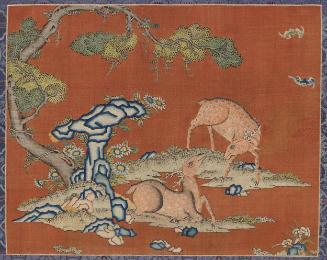
approx. 1800-1900

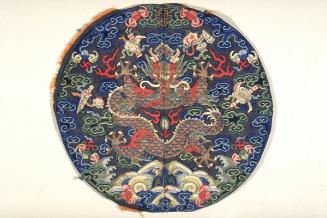
approx. 1850-1911
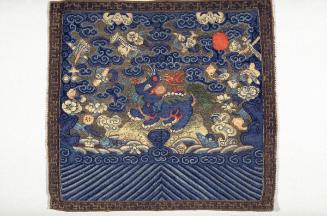
approx. 1860-1911
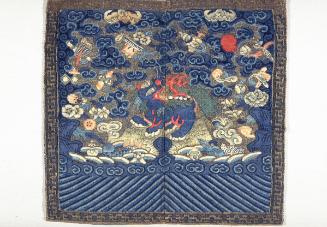
approx. 1860-1911
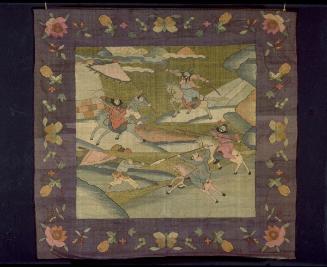
approx. 1800-1911
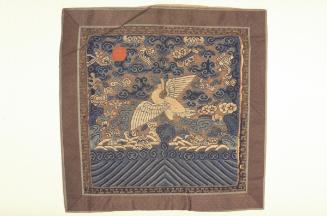
approx. 1800-1911
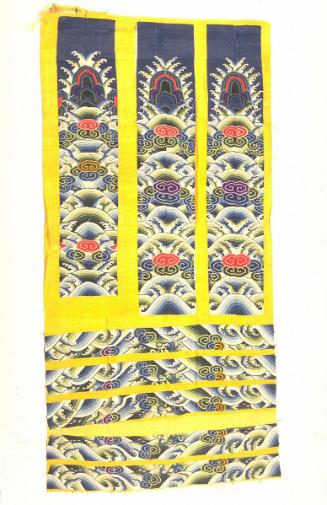
approx. 1800-1911