
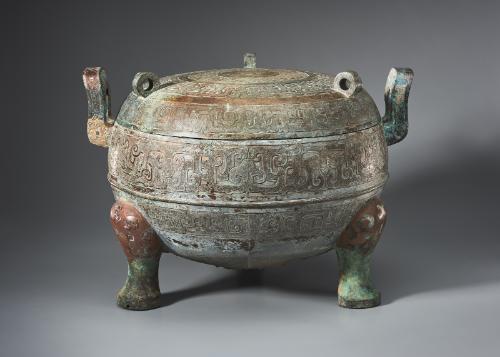



Ritual food vessel (ding) with cover
The Liyu' style, named after a village in northern Shansi, is the most distinctive one of the Late Zhou period. Robust and elegant, shapes are almost classical in their rotundity, simplicity and directness. Perfectly adapted to these shapes, the ebullient decor, tempered by strict symmetry consists essentially of uninterrupted circular bands of more or less abstracted animal shapes in low relief and filled with granulated or thread-like details, the latter being usually variants of the round-and-triangular volute.
Ii one makes abstraction of sculptured animals on the cover and of high relief masks on the legs, the large ding (B60B29+) looks, at first glance, like an enlargement or the one we have just described. The decorative motifs, however, are quite different. The center of the cover is occupied by a quatrefoil. This is one of the first representations of a motif which will become very popular in Han times. It reflects a major turning-point in an art which for a thousand years had pointedly avoided allusions to the vegetable kingdom.
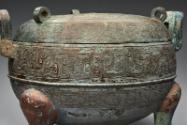
Starting from the top the first, second and fourth bands are filled with the same pattern: a maze of interlaced animal shapes centering on bovine masks seen in front view. The third and fifth bands form continuing friezes of spiraling and regardant dragons with enormous proboscis and crests.
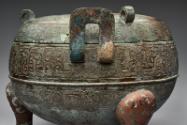
The details of all these designs are rendered by granulation, striation, barbed spirals or round and triangular volutes. The three rolled rings on the cover with their overlaps are incised with spirals.
The upper parts of the cabriole legs are decorated with dissolved monsters' masks in copper inlay flush with the surface. This is a technical innovation of the period. The same technique was used to decorate the narrow sides of the sturdy L-shaped handles.


