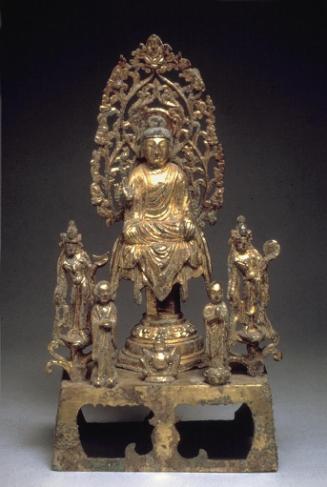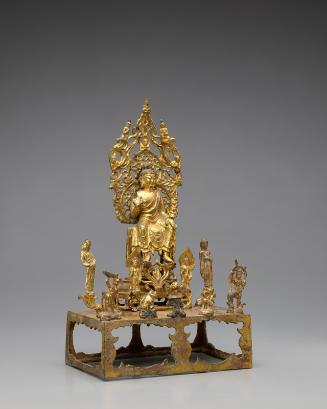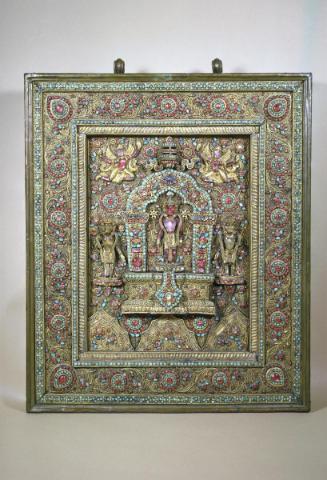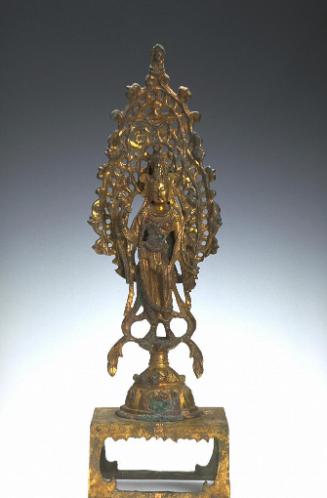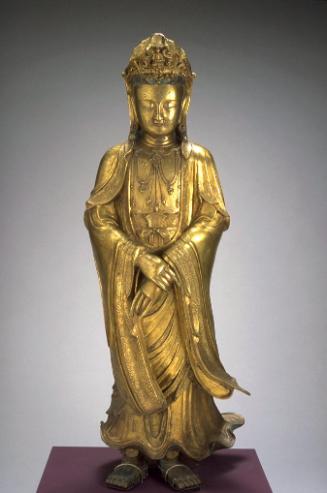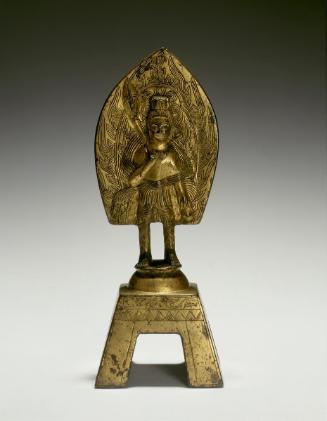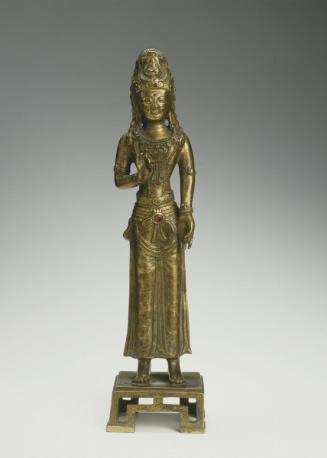




The bodhisattva Avalokiteshvara (Guanyin) flanked by attendants
- Gallery Location Gallery 16
Gilt Bronze Buddhist Sculpture, 200-577 CE
While these small gilt bronze Buddhist sculptures represent many of the artistic and iconographic Buddhist issues of their day, they offer only a hint of Buddhism's glories and of how widespread its practices were. This excerpt of an account of the Northern Wei capital from Luoyang offers a marvelous (if somewhat romanticized) description of that city at its prime (500-535):
In the Yongning monastery was a nine-storied pagoda built with a wood frame that rose nine hundred feet high. Its golden pole rose another hundred feet so that its total height was a thousand feet. . . . On the top of the pole was a precious golden vase with a capacity of twenty-five bushels under which were eleven golden dishes for collecting the dew; these were hung all around with golden bells. The pole was supported by four iron chains running to the corners of the pagoda, and on them were more golden bells the size of bushel pots. . . . When the bells chimed in harmony deep in a windy night they could be heard over ten li [about three miles] away.
North of the pagoda was a buddha hall modeled on the Taiji [supreme ultimate] Hall of the palace. In it were an eighteen-foot-high gold statue, ten human-sized gold statues, three statues studded with pearls, five statues woven from gold thread, and two jade statues. They were all of brilliant and unmatched artisanship. . . . (Adapted from the translation by W.F.J. Jenner, Memories of Loyang, pp. 148-49).
- bodhisattva
- Avalokiteshvara