
Buddha's hand citron
- Gallery Location Gallery 13
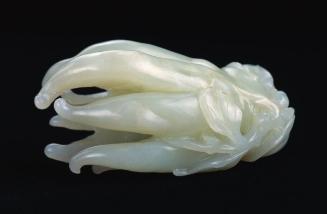
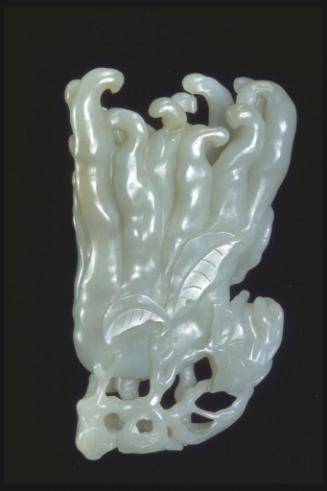
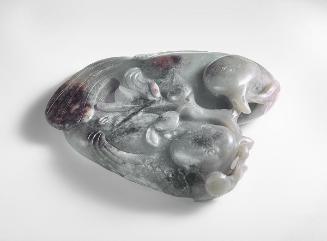
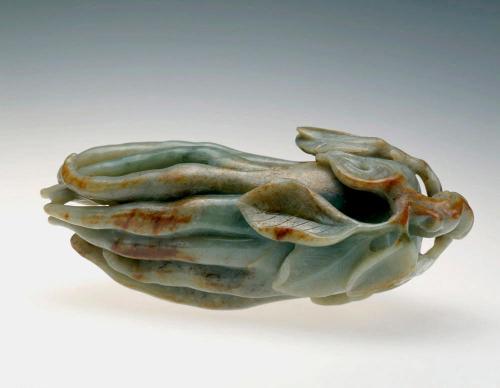
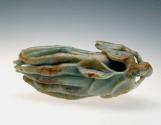
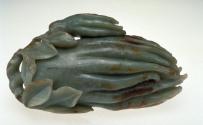
This water container, worked from a large jade pebble of gray–green nephrite with dark specks and brown areas artificially enhanced, is conceived in the shape of a Buddha's-hand citron. An open fold among its many fingers forms the opening. A smaller fruit, growing from the same branch, enhances the composition. It is a masterful piece of carving, typical of the spirit of the Ming dynasty.
The Buddha's-hand citron ( citrus medica var. sarcodactylis) is formed completely of rind and is therefore inedible. However, after treatment the rind can be used medicinally. The fruit itself has a strong fragrance. In China it is used for perfuming one's surroundings, and also as an altar offering during Chinese New Year. The Empress Dowager Cixi (1835–1909) preferred the fragrance of fresh fruit to regular incense; large bowls of Buddha's-and citrons, as well as quince and apples, were used to perfume her palace. The shape of this fruit resembles the fingers of the Buddha, hence its name foshou, or Buddha's-hand.
The pronunciation of the name foshou resembles that of the words "blessings (fu)" and "longevity (shou)." During the Qing dynasty, this auspicious fruit was used frequently in the decorative arts of China as a rebus for blessings. It was often combined with the peach (longevity) and pomegranate (numerous offspring) to form the motif of "Three Plenties" (see B60 J327).