

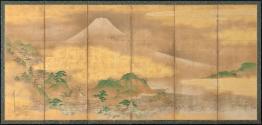
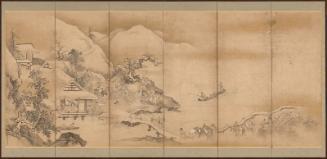
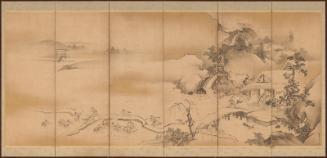
Mt. Fuji
Artist
Kanō Tan'yū
Japanese, 1602 - 1674
Place of OriginJapan
Date1666
PeriodEdo period (1615-1868)
CultureJapanese
MaterialsInk, colors and gold on paper
DimensionsH. 65 3/8 in x W. 144 1/4 in, H. 166.1 cm x W. 366.4 cm (image); H. 71 3/4 in x W. 149 in, H. 182.2 cm x W. 378.5 cm (overall)
Credit LineThe Avery Brundage Collection
Object numberB63D7.a
DepartmentJapanese Art
ClassificationsPainting
On View
On viewLocation
Text Entries- Gallery Location Gallery 28
On this screen, partly hidden buildings of the Kiyomidera Temple can be seen in the middle ground below the mountain. At the foot of the hill is the Kiyomigaseki, a travelers' checkpoint that had survived from the Heian period (794–1185) although it was not in use in Tanyu's time.
An extremely prolific and important master of the Kano family school, Kano Tanyu moved from Kyoto to Edo (now Tokyo) and established a strong connection with the shogun's court. While Tanyu continued to work in Edo as an official court painter for the shogun, he also established his own branch of the Kano school. Under Tanyu's leadership, the new school gained political and artistic power in Edo.
An extremely prolific and important master of the Kano family school, Kano Tanyu moved from Kyoto to Edo (now Tokyo) and established a strong connection with the shogun's court. While Tanyu continued to work in Edo as an official court painter for the shogun, he also established his own branch of the Kano school. Under Tanyu's leadership, the new school gained political and artistic power in Edo.
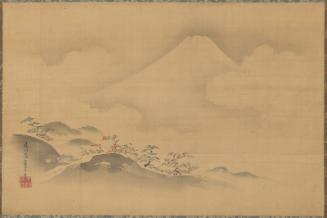
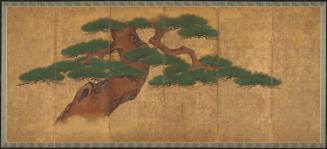
Kanō Tan'yū

Kanō Tan'yū
Kanō Tan'yū

Pair/Pair