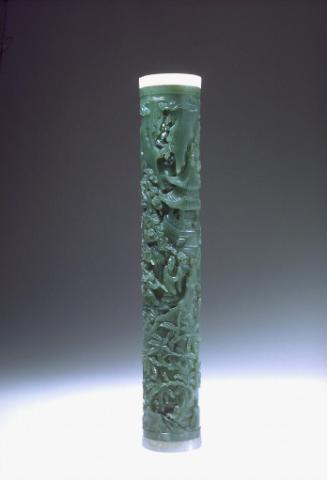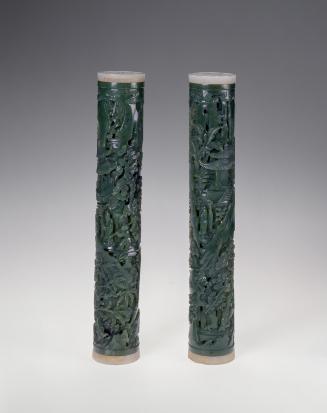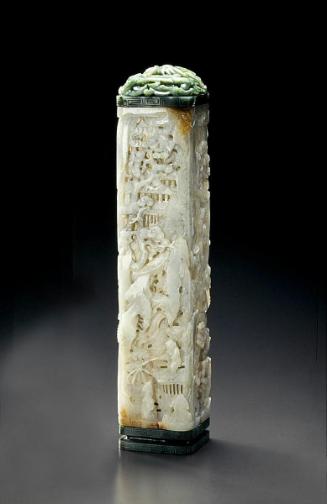
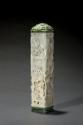
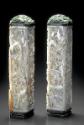
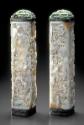
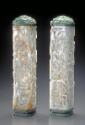
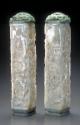
Censer, one of a pair
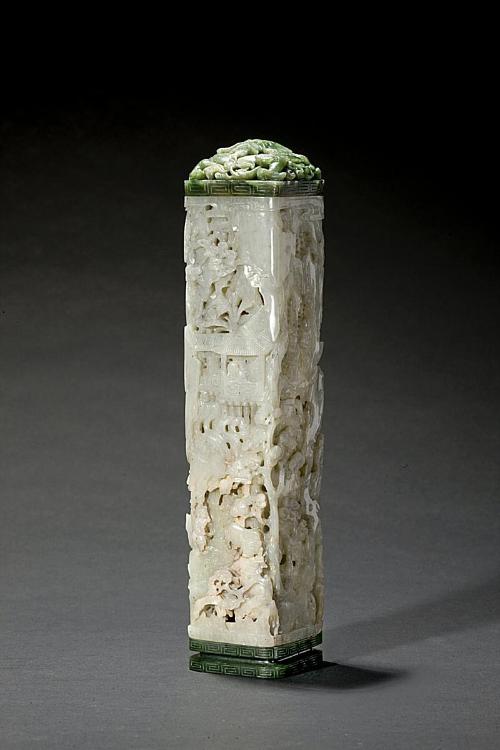
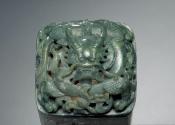
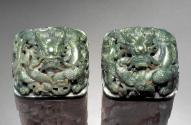
These censers are formed of grayish-white nephrite; the areas with cracks and fissures have been artificially enhanced. The censers are decorated with an intricate landscape in openwork, with overlapping layers of rocks. Openwork dragons surmount the top of each censer, resting on a square base incised with a band of square meanders. The square bottom, decorated with two bands of meanders, has a raised circular section. A tiny hole has been drilled in the center to hold the joss stick in place. The circular section is threaded so it can be screwed into the bottom of the censer. This pair of censers is a variation on the carved bamboo prototypes of the Ming dynasty, which are fitted with wooden ends stained a darker shade. In this example, the ends are of spinach green Manasi jade with black specks.
The figures in the landscape represent the "four noble professions" of China: fisherman, woodcutter, farmer, and scholar. One censer features a young farmer plowing his fields with his buffalo; another man returns home with his hoe on his shoulder. The scene above shows an old scholar, a book in hand, admiring the rocks. Two young servants approach a young scholar, who appears to be looking at the cascading stream below his pavilion.
On the other censer, woodcutters are returning home with their firewood from the hills above. Below are fishermen in various activities. Some are conversing in their boats, others are carrying fishing poles and baskets, while a lone figure standing on a pier over a flowing stream lifts his heavy net.
For a Qianlong period example, see Zgyqqj 1991, vol. 6, [page no.?], plate 84.
- fisherman
- pavilion
- farmer
- boy