
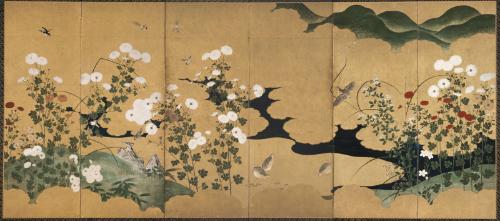
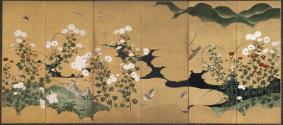
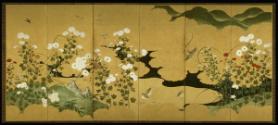

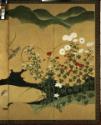
Birds and autumn plants, one of a pair
Place of OriginJapan
Dateapprox. 1700-1800
PeriodEdo period (1615-1868)
MaterialsInk, color and gold foil on paper
DimensionsH. 61 3/8 in x W. 138 3/8 in, H. 156 cm x W. 351.4 cm (image); H. 67 3/4 in x W. 145 1/2 in, H. 172.1 cm x W. 369.6 cm (overall)
Credit LineThe Avery Brundage Collection
Object numberB60D76+
DepartmentJapanese Art
ClassificationsPainting
On View
Not on viewAutumn’s flower
The chrysanthemum in Japan is a symbol of autumn. This pair of folding screens (B60D75+ and B60D76+) depicts a medley of fall flowers and plants—including white, red, and pink chrysanthemums, wispy eulalia (Miscanthus), and bush clover. Luxurious screens like these were a staple of wealthy Japanese households, where they served as room dividers or interior decoration. The images on the screens tended to harmonize with the season or served other felicitous purposes.
For the Japanese, the chrysanthemum is especially significant: it is a symbol of their country. A sixteen-petal chrysanthemum (kiku) serves as an emblem of the emperor and the imperial family.
(Label from exhibition Flower Power)

approx. 1700-1800

Matsumura Keibun
approx. 1750-1800
approx. 1650-1700

approx. 1615-1700
1700-1750
1800-1900
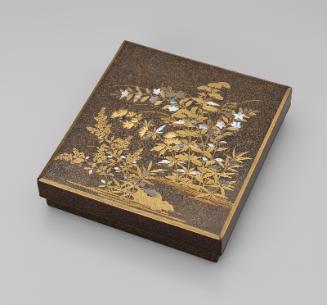
approx. 1675-1725
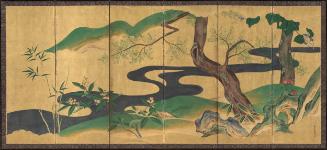
Pair/Pair