
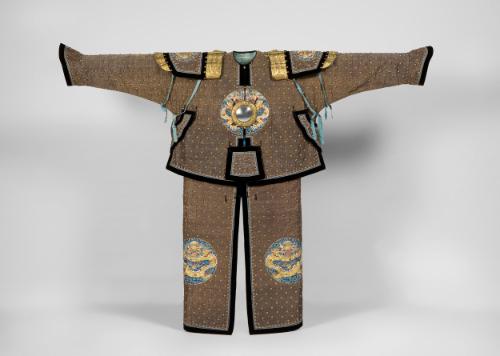
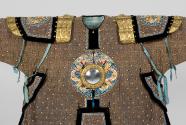
Manchu warrior’s ceremonial armor costume
Place of OriginChina
Dateapprox. 1900
DynastyQing dynasty (1644-1911)
MaterialsSilk brocade, velvet, and gilded metal appliqué
Dimensions(.a Jacket) H. 29 1/4 in x W. 78 1/2 in, H. 74.3 cm x W. 199.4 cm; (.b-.c Panels under arms) H. 9 1/2 in x W. 10 1/4 in, H. 24.1 cm x W. 26 cm; (.d Skirt Panel) H. 43 1/4 in x W. 47 in, H. 109.9 cm x W. 119.4 cm; (.e-.f Epaulets) H. 17 1/2 in x W. 19 3/8 in, H. 44.5 cm x W. 49.2 cm; (.g Inner Cap) H. 8 3/4 in x W. 7 7/8 in x D. 8 3/8 in, H. 22.2 cm x W. 20 cm x D. 21.3 cm; (.h-.i Medallions) diam. 6 1/2 in, diam. 16.5 cm; (.j Flap) H. 7 1/4 in x W. 8 1/2 in, H. 18.4 cm x W. 21.6 cm; (.k Headress) H. 23 in x W. 11 1/4 in x D. 9 in, H. 58.4 cm x W. 28.6 cm x D. 22.9 cm; (.l Feather for Headress) L. 22 1/2 in, L. 57.2 cm
Credit LineGift of Dodie and John N. Rosekrans, Jr.
Object number1994.22.a-.m
DepartmentChinese Art
ClassificationsTextiles
On View
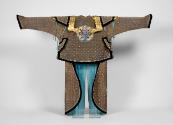
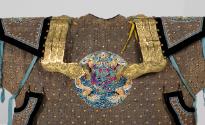
Not on viewThe military garments of the Manchus, who originally came from northeastern China, reflect their lifestyle. The armor consists of a waist-length padded garment with a matching skirt, bearing medallions embroidered with dragons and other auspicious motifs. The lower garment has a split down the center for ease of riding, and the sleeves have horse hoof–shaped cuffs to protect their hands in inclement weather. Following Chinese tradition, the chest and back are guarded with a “heart-protecting mirror.” The shoulders have extra padded pieces for protection, attached to the garment with buttons and decorated with perforated gilded metal reliefs. A trapezoid hanging piece protects the belly. By the beginning of the nineteenth century, such garments could no longer protect the wearer from powerful modern weapons. These were mainly worn by imperial guards or warriors for ceremonial functions.
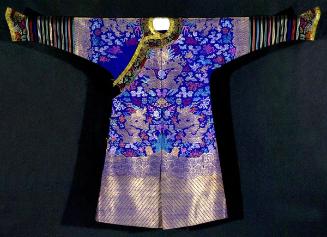
approx. 1850-1900
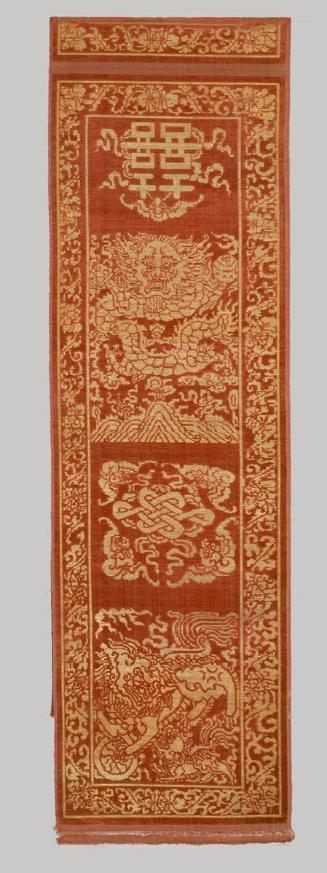
prob. 1750-1911
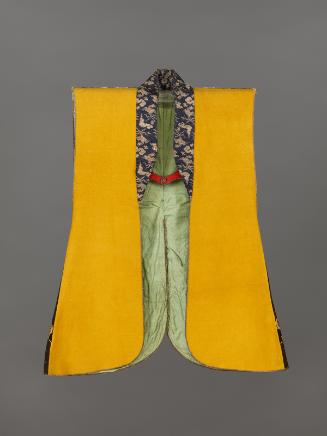
approx. 1750-1850
approx. 1880-1930

approx. 1850-1911
approx. 1850-1911
approx. 1800-1900
approx. 1900-1950
1800-1900