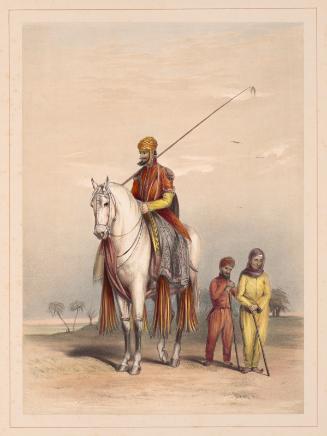
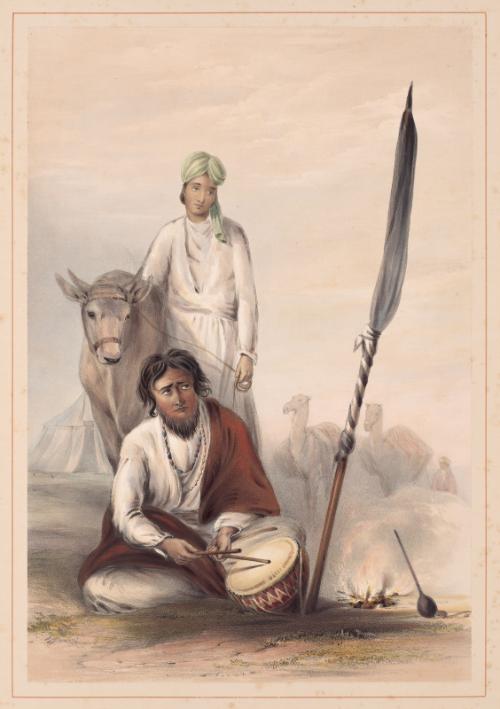
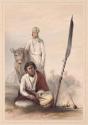
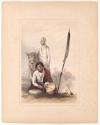
A Fakeer at an Army Camp
“Large Indian camps have a Fakeer [sic] attached to each, who sits, with his staff stuck in the ground, and beating a drum, by the road-side, near the encamping grounds, to which he points out the path, with loud cries of prayer for the welfare of each passerby. His office is a welcome one, at the conclusion of a tedious, and often hot morning’s march; and he is generally rewarded when all the marches of a journey are over, by the contents of a subscription purse, raised among the members of a camp.”
—Excerpt from Emily Eden, Up the Country: Letters Written to Her Sister from the Upper Provinces of India, 1866
The word fakir (Arabic, faqir, “one who is poor”) originally applied to wandering Muslim mystics, but was used in India to refer to Hindu ascetics as well. Eden does not specify the religious faith of the man depicted here.
- portrait
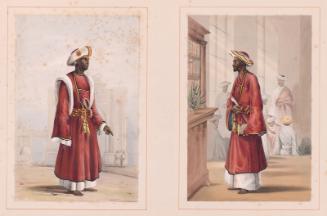

![[1] Young Student at the Hindu College in Calcutta, [2] A Child of One of the Servants of Government House](/internal/media/dispatcher/67726/thumbnail)