Turban
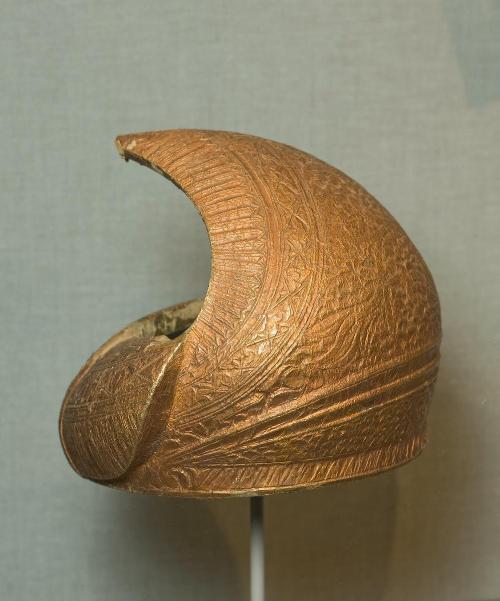
This golden turban, created by the Minangkabau peoples of West Sumatra, bears intricate designs that evoke the ornate patterns typically appearing on textiles from the island, many of which were folded to form headdresses for both women and men. The type of cloth and manner of folding were distinctive to individual villages and markers of family identity and by extension social status.
This turban, however, is no textile, despite the fact that it features textile-based designs. Here, specific patterns were first carved into the wood. Then, the artist capitalized on the malleability of gold to press the designs onto the turban’s luminous surface, thus making this headgear relatively more permanent than one of folded cloth. Such turbans were typically worn by men on ceremonial occasions, their gold decoration underscoring the status and thus political leverage of the wearer.
(Label from Exhibition Hidden Gold: Mining Its Meaning in Asian Art)