



The Buddhist lama Padmasambhava as Guru Drakpochey
Place of OriginTibet
Dateapprox. 1525
MaterialsColors on cotton
DimensionsH. 10 3/4 in x W. 5 1/8 in, H. 27.3 cm x W. 13.0 cm (image); H. 20 3/4 in x W. 9 1/2 in, H. 52.7 cm x W. 24.2 cm (mount)
Credit LineGift of the Connoisseurs' Council
Object number1992.344
DepartmentHimalayan Art
ClassificationsPainting
On View
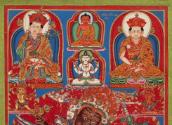
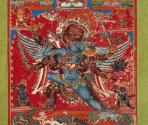
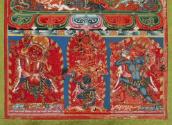
Not on viewFor Tibetan Buddhism’s earliest Nyingma teachings to survive the era of Buddhism’s near extinction in the region (850–1000), extraordinary intervention was required. Anticipating this period, the lama Padmasambhava concealed the teachings in both physical locations and in the minds of his students. These hidden treasures (terma) would be rediscovered at prescribed future times, whether unearthed from the ground or recovered from the minds of those disciples in subsequent rebirths. The dark-red winged deity embracing his blue consort at the center of this painting embodies one of those hidden teachings, recovered by Pema Lingpa (seated upper right) around the turn of the sixteenth century. This deity, Guru Drakpochey, is a fierce manifestation of Padmasambhava himself (upper left), capable of destroying all obstacles, however dreadful, to enlightenment.
Video: Time Travel in Two Tibetan Thangkas (Part 1 of 2): http://youtu.be/uCNCNfsFmXc
Video: Time Travel in Two Tibetan Thangkas (Part 2 of 2): http://youtu.be/vr5D0mzyiLk
Jeffrey Durham, Curator of Himalayan Art at the Asian Art Museum, discusses two iconic masterworks in the museum's collection of Himalayan art. A lecture presented by the Society for Asian Art on May 1, 2015
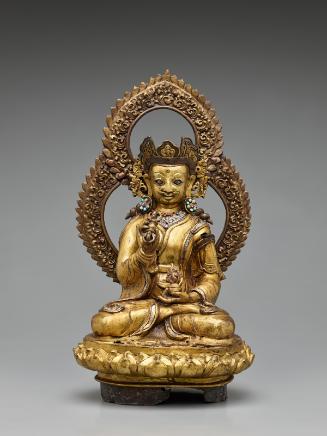
approx. 1500-1600
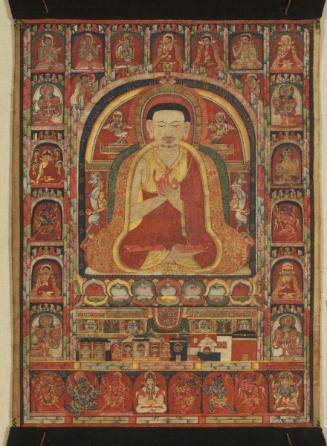
1210-1273
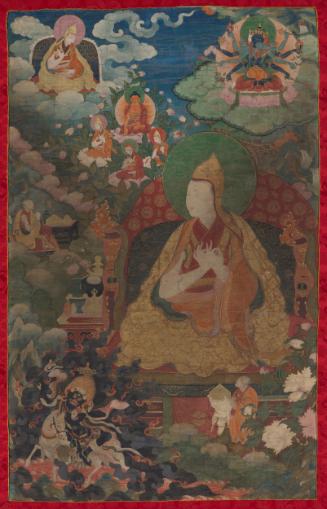
1700-1800

1700-1800
1800-1900
1800-1900
1700-1800
1700-1800