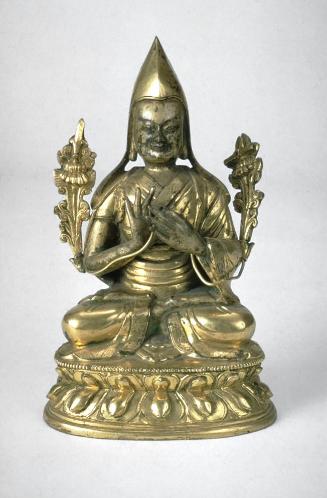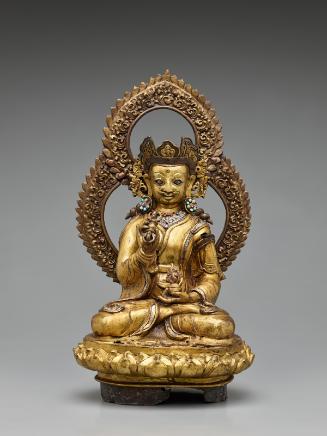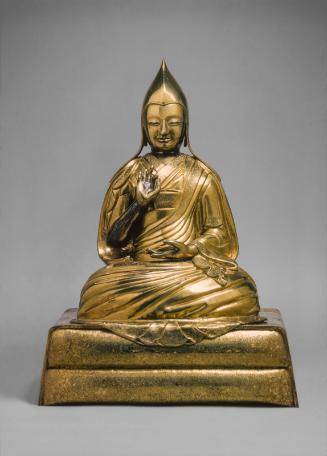

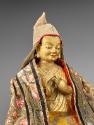

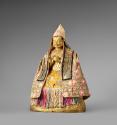
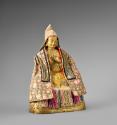
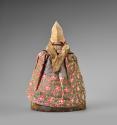
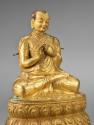
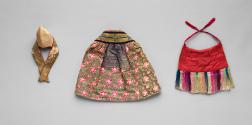


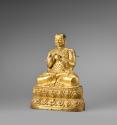
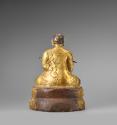
The lama Tsongkhapa
- Gallery Location Gallery 12
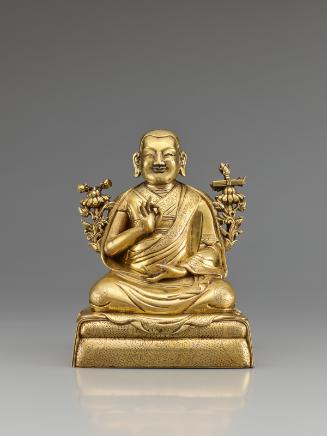
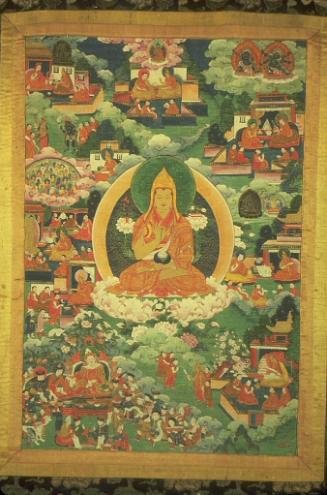
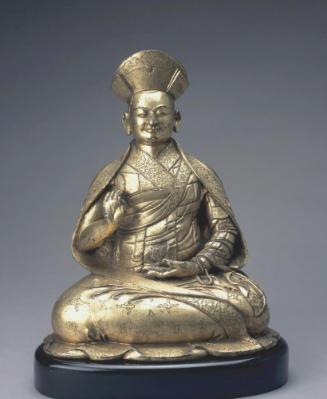
Tsongkhapa Losang Drakpa (1357–1419), the Man from Onion Valley, was a polymath scholar and one of Tibet’s most ingenious monastic leaders. Founder of the Gelug school whose Dalai Lamas would soon rule Tibet, the Man from Onion Valley transformed Buddhism in Tibet with his unmatched brilliance in philosophy, ethics, and meditation. A native of Amdo in eastern Tibet, Tsongkhapa was considered an emanation of Manjushri, the bodhisattva of wisdom. He demonstrated miraculous abilities, such as reciting mantras before he could speak and receiving visions of deities. In this respect his biography presents many similarities to that of Karma Pakshi (see his sculpture in this case).
Tsongkhapa’s tireless pursuit of knowledge took him to renowned masters across Tibet. He synthesized the teachings of Madhyamaka (emptiness philosophy), Vinaya (monastic discipline), and Tantra (structured meditation) into a coherent system. His two magnum opuses, the Lamrim Chenmo (Great Treatise on the Sutra) and Ngakrim Chenmo (Tantra systems), treat the entire immensity of the Buddhist path with unequalled clarity and detail.
Tsongkhapa’s crowning achievement was the establishment of Ganden Monastery, from which the Gelug tradition of the Dalai Lamas would spread. At his death miraculous signs including rainbows and flowers falling from the sky manifested. In Buddhist thought such signs are the confirmatory correlates of important spiritual developments.